
R01 – Redesigning Digital Clinical Decision Support Tool for Implementation of PST for Depression
Principal Investigators
Patrick J. Raue, PhD, Professor, Department of Psychiatry & Behavioral Sciences, University of Washington
Ian M. Bennett, PhD, Professor, Department of Family Medicine and Psychiatry & Behavioral Sciences, University of Washington
Sean Munson, PhD, Professor, Department of Human-Centered Design & Engineering, University of Washington
Project Description
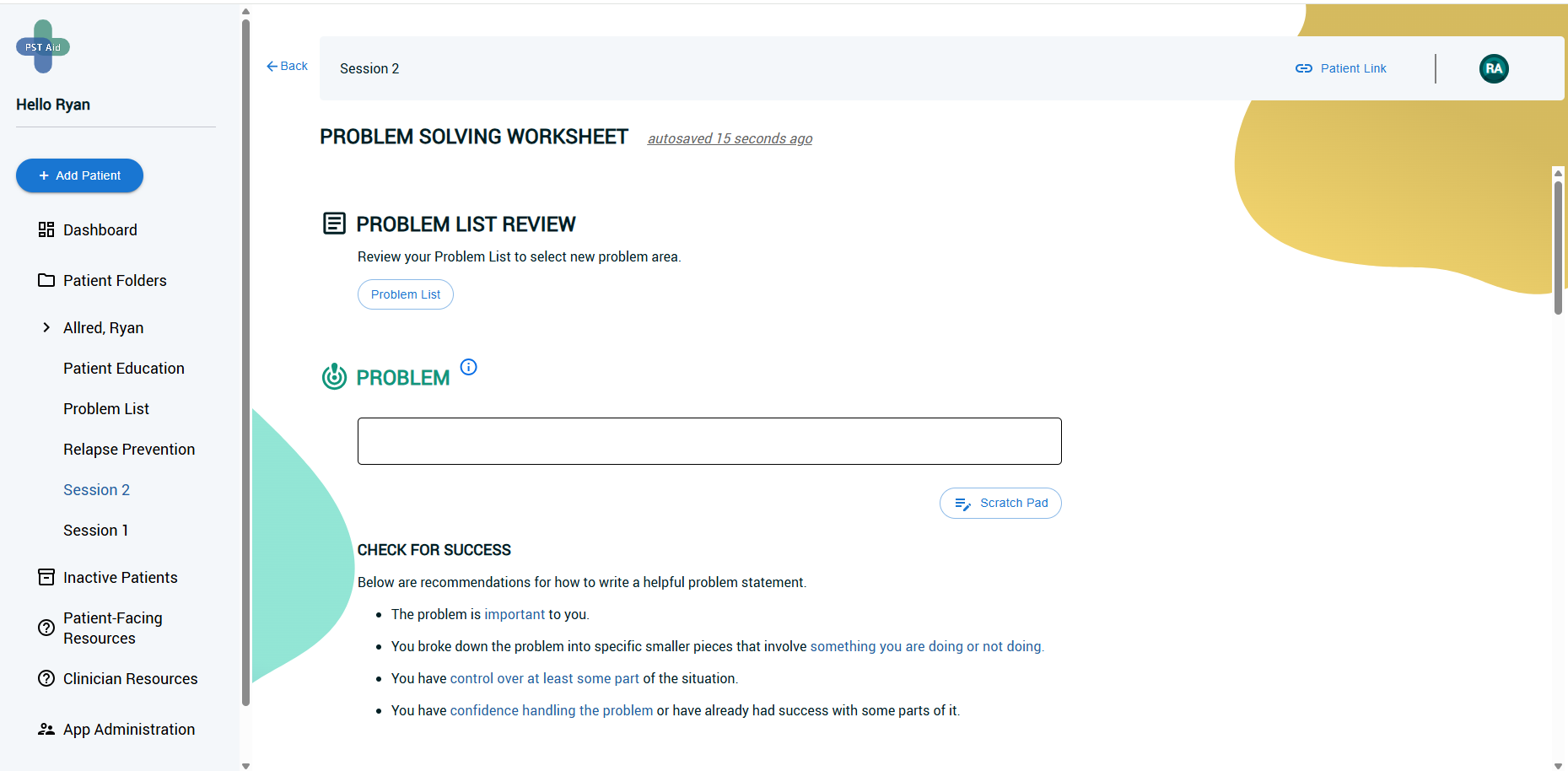
Evidence-based clinical interventions are often delivered with poor fidelity and abandoned by practitioners soon after training. In response to these findings, we have worked with primary care practitioners and patients to co-design an automated decision support tool supporting Problem Solving Treatment (PST) for depression. PST Aid is a web-based app that promotes practitioner–patient collaboration in the use of PST for goal setting and action planning, which we conceptualize as an “educate and reorganize” implementation strategy.
This project started during the first iteration of the UW ALACRITY Center as an R34 project. The current project focuses on redesigning PSTAid by working with clinicians and patients from our partnering OCHIN health informatics network, which includes more than 300 independent community health centers across 45 states serving 130,000 unique patients monthly. We will conduct a hybrid type III effectiveness-implementation randomized clinical trial comparing standard PST implementation with PST implementation augmented by the PSTAid implementation strategy.
| Setting | OCHIN Community Health Centers |
| Population | Adults with depressive symptoms (PHQ-9 > 10), Practitioners |
| Timeline | April 2023 to April 2028 |
Intervention and/or Implementation Strategy Designed or Redesigned
| Intervention | Problem Solving Treatment (PST): an evidence-based, skills-based intervention for depression that teaches patients a 7-step approach |
| Implementation Strategy | PST Aid: a web-based app that promotes provider–patient collaboration in the use of PST for goal setting and action planning |
Anticipated Impact
Patient- and practitioner-centered clinical decision support systems embedded in health information technology tools have the potential to enhance appropriateness, engagement, and usability of PST, an evidence-based practice. The ability to support fidelity to the elements of a clinical intervention, while at the same time reducing burden, would represent a major step forward for the delivery of care and would have implications for a range of other effective, but seldom used interventions. This project will gather invaluable data to inform other clinical interventions that are based in shared decision-making around goals and action plans (e.g., Cognitive Behavioral Therapy, Motivational Interviewing, Behavioral Activation).
Project Publications
Problem Solving Treatment for Depression: Development and Pilot of an Internet-Based Support Tool Created Through Human Centered Design
Journal of Participatory Medicine
Authors
Ian M. Bennett; Patrick J. Raue; Sean A. Munson; Michael D. Pullmann; Ryan J. Allred; Brittany Mosser; Alejandra Lopez; Emily Friedman
Abstract
Background: While Problem Solving Treatment (PST) for depression is an effective psychotherapy in primary care settings, it is not widely used and clinician fidelity to key elements drops quickly following training. Human-centered design (HCD) methods may help identify and address usability barriers that limit adoption and fidelity of evidence-based psychotherapies.
Objective: This study aimed to use HCD methods to identify usability barriers in PST delivery, co-design a clinician- and patient-centered solution, and carry out a feasibility pilot study for implementation and clinical outcomes of this prototype.
Methods: Using the Discover, Design, Build, and Test (DDBT) framework, we conducted observations and interviews with PST-experienced clinicians to identify usability challenges in PST delivery. Findings informed iterative co-design and development of PST Aid, a web-based clinical decision support and workflow support tool for PST. The resulting prototype underwent usability testing and was subsequently evaluated in a small pilot study incorporating clinician-level randomization to PST Aid or PST as usual. Measures include feasibility, usability, acceptability, clinician certification and fidelity measures, and patient depression outcomes.
Results: The Discover phase identified multiple usability barriers affecting PST delivery, including perceived rigidity of the intervention, difficulties maintaining patient engagement and ownership of the problem-solving process, challenges with patient understanding of PST concepts, and inconsistent support for between-session activities. These findings informed rapid prototyping cycles carried out with co-design clinicians (9 undergoing PST training-as-usual and 10 experienced PST clinicians) and their patients (n = 4), which led to a web-based application that served to support and “scaffold” PST tasks as well as provide decision support for both providers and patients (PST Aid app). PST Aid features included interactive guidance prompts, structured problem tracking, and enhanced action planning tools. In pilot testing, clinicians rated PST Aid as having above-average usability (System Usability Scale score=76), while patients rated usability as acceptable (score=65). Acceptability, feasibility, and appropriateness ratings were high among both clinicians and patients. Clinicians using PST Aid demonstrated faster certification trends and encouraging fidelity maintenance compared with PST as usual, although the study was not powered for statistical comparison of these outcomes. Patients treated with PST Aid showed directionally greater reductions in depressive symptoms and a higher proportion achieved PHQ-9 scores below 10 at follow-up, though these findings should be considered exploratory given the small sample size.
Conclusions: This study demonstrates the feasibility of applying HCD methods to identify implementation barriers and develop usability-focused supports for PST in primary care settings. The resulting prototype showed favorable usability, acceptability, and preliminary implementation signals in a small pilot study. These findings support further evaluation of HCD-informed implementation supports for evidence-based psychotherapies in larger, fully powered trials.